I Don’t Want Five AI Employees. I Want One Really Good One.
Spend five minutes on LinkedIn and you’ll see some version of the same promise.
“Replace your marketing team.” “Fire your assistant.” “Run your company with twelve AI agents that never sleep.”
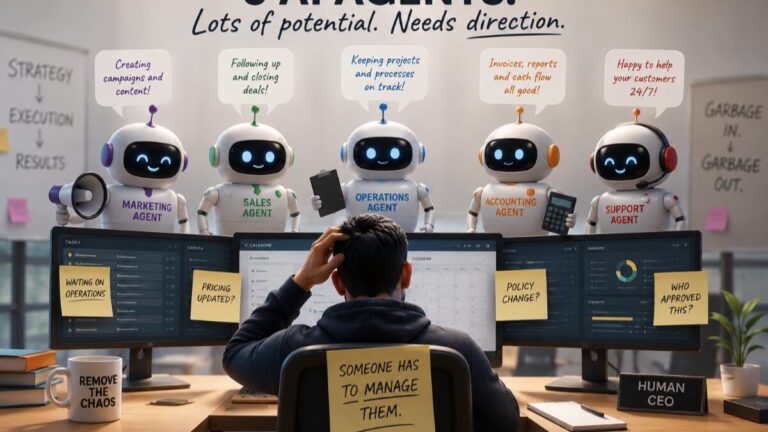
The ads usually feature adorable little cartoon employees. One’s wearing glasses. Another has a headset. One is apparently your CFO. They all smile like they’ve been working together for years.
I get it. It’s clever marketing.
But every time I see one of those ads, I find myself asking the same question:
“Who’s managing them?”
Because somebody has to.
Don’t get me wrong. I love AI. I use it every single day. It helps me write faster, research faster, organize information faster, and think through problems from angles I may not have considered. I genuinely believe we’re living through one of the biggest shifts in the way people work.
What I don’t believe is the idea that AI magically removes the need for people.
In fact, I think the opposite is true.
AI doesn’t remove chaos. It amplifies whatever already exists.
If your business already has documented processes, organized systems, and clear communication, AI can make your team dramatically more productive. But if your business lives inside sticky notes, scattered Slack messages, and whatever the CEO remembers that morning, AI isn’t going to fix that. It’s simply going to make the confusion happen faster.
That’s not innovation.
That’s efficient chaos.
Take a typical business for example.
- Marketing launches a promotion.
- Sales starts selling it immediately.
- Operations has no idea the offer exists.
- Accounting invoices using last month’s pricing because nobody updated the system.
- Customer support is still referencing an outdated policy they pulled from the knowledge base six weeks ago.
None of those AI agents failed.
Each one did exactly what it was told to do.
The business failed because nobody was coordinating the work.
That’s the part the advertisements skip over.
Businesses aren’t built around routine days. They’re built around exceptions. A client needs special billing. A nonprofit has grant restrictions. A VIP customer asks for something outside the normal process. The CEO changes direction halfway through the week because a new opportunity appeared.
Those moments don’t require faster typing.
They require judgment.
That’s why I think so many founders are asking the wrong question. Instead of asking, “How do I replace my people with AI?” they should be asking, “What repetitive work can AI eliminate so my people can focus on the work that actually requires experience?”
Those are two very different conversations.
I don’t need AI to build trust with a client. I need it to summarize the meeting so I can stay focused on the conversation.
I don’t need AI making final decisions. I need it drafting the first version so I can improve it.
I don’t need AI pretending to be an operations manager. I need it making a great operations manager even better.
That’s where I believe this is all heading.
Five years from now, I don’t think anyone will brag about using AI. It’ll be as ordinary as email, spreadsheets, or Zoom meetings. The competitive advantage won’t be having access to the technology. Everyone will.
The advantage will belong to the companies that know how to combine technology with human judgment.
That’s a future I’m excited about because it doesn’t replace people.
It gives good people superpowers.
And if you’ve followed me for any length of time, you already know what I believe.
Productivity has never been about choosing between technology and human expertise.
It’s always been about combining the two.
That’s how you remove the chaos.